
Key Takeaways
- ✓ Can You Sand Metal? Yes, sanding is essential for removing rust, old paint, and rough edges, as well as preparing metal for a new coating.
- ✓ Key Tools: You will need an abrasive tool (sandpaper, sanding discs, etc.), a sander (power or hand), and safety gear (goggles, mask, gloves).
- ✓ Grit Progression: Always start with a coarse grit (like 60-80) to remove material and work your way up to finer grits (like 220-400+) for a smooth finish.
- ✓ The Golden Rule: Never skip grits. Each grit's job is to remove the scratches from the previous one.
- ✓ Can regular sandpaper be used on metal? No. Wood sandpaper will clog quickly on metal and wear out fast. For best results, use metal-rated abrasives with stronger backing and appropriate grain adhesion.
- ✓ Grinding vs Sanding: Grinding (under 60 grit) is for aggressive material removal (like welds/rust). Sanding (60+ grit) is for finishing, smoothing, and preparation.
Introduction: Why Sanding Metal is a Critical First Step
Whether you're restoring a rusty piece of patio furniture, prepping a car for paint, or smoothing a rough weld, sanding is the non-negotiable step that separates an amateur job from a professional finish. But if you're new to metalwork, you might be asking, "Can you sand metal like you sand wood?"
So, can you sand metal? Absolutely. In fact, it's the critical first step for almost any metal project. Sanding does three essential jobs:
- Removes Imperfections: It strips away rust, old paint, pitting, and corrosion, revealing a clean, workable surface.
- Creates a "Tooth": On a microscopic level, sanding creates fine scratches. This "tooth" gives primer and paint something to grip, ensuring a durable bond that won't chip or peel.
- Deburrs & Finishes: It removes sharp, hazardous edges (called "burrs") left over from cutting or creates a beautiful, decorative "brushed" look.
In this guide, we'll cover the exact tools, abrasives, and step-by-step techniques you need to sand any metal like a pro.
Pre-Sanding Essentials: Preparation for a Flawless Finish
Before you get into the actual sanding process, there’s a bit of prep to do.
Pre-Sanding Step 1: Surface Inspection and Cleaning
- Identify Your Metal: Different metals have unique properties. For example, aluminum is soft and scratches easily, while steel is much tougher. Knowing what your material is will help you choose the right abrasives and techniques.
- Thorough Cleaning: Start by wiping away any loose dirt and debris. Next, wash the entire surface with a solution of mild soap and water, or a dedicated degreaser, to remove all traces of oil, grease, and other contaminants. Sanding over these contaminants embeds grime into the metal's surface and prevents paint or primer from forming a proper bond.
- Completely Dry: The metal needs to be completely dry before you begin sanding. Any moisture, especially on ferrous metals like steel, can cause new rust to form almost immediately.
Pre-Sanding Step 2: Removing Heavy Rust and Old Coatings
For surfaces with rust, scale, or multiple layers of paint, removing this now will be much more efficient than starting with sandpaper alone. Your goal here is to strip away the bulk of the unwanted material before proceeding to finer sanding.
- Wire Brushes: Mounted on a drill or angle grinder, wire brushes are great tools for removing loose rust, flaking paint, and mill scale. They are available in two main types: crimped wire brushes are more flexible and less aggressive, making them good for general cleaning, and knotted wire brushes are stiffer and more aggressive for heavy-duty cleaning and weld spatter removal. [Shop for Wire Wheels & Brushes]
- Flap Discs: A versatile abrasive, flap discs excel at removing rust and old coatings. They offer a great balance of material removal and initial blending, making them a popular choice for surface restoration. [Shop for Flap Discs]
- Strip Discs: Designed specifically for removing paint, rust, and oxidation without damaging the base metal. Made from open-web, non-woven fibers, they run cooler and resist loading better than traditional abrasives. Ideal for prepping metal surfaces before sanding, welding, or refinishing. [Shop for Strip Discs]
Grinding Metal vs. Sanding Metal: What's the Difference?
These terms are often mixed up, but they mean different things.
- Grinding: This is aggressive removal. It uses low-grit abrasives (like 24, 36, or 60 grit) on tools like an angle grinder to remove a lot of material quickly (grinding down a weld or thick rust removal).
- Sanding: This is for finishing and finesse. It uses higher-grit abrasives to smooth the surface, prep it for paint, or polish it.
Selecting Abrasives and Sanders for Metal
The tools you choose for sanding metal will depend on the type of metal and the type of project you’re working on. A large rusty car hood requires a different approach than sanding a delicate piece of aluminum trim. Here’s a breakdown of what you'll need.
1. The Abrasive Choices (The "Sandpaper" Itself)
Can you use regular sandpaper on metal? This is a common question we often get, and the answer is no. Standard "wood" sandpaper (often reddish-brown and made of garnet) is too soft for metal sanding. It will clog and/or wear out fast, and won't be effective on hard surfaces like steel. For metal, you need specific abrasive grains that are properly bonded to a stronger backing.
Abrasive Grain Types:
The grains are the small minerals that coat your abrasives and do the cutting and sanding. Different grains have different properties, making them suitable for different applications
| Abrasive Grain | Primary Application & Best Metal Types | Key Advantage in Sanding | Wet Sanding / Polishing Suitability |
|---|---|---|---|
| Aluminum Oxide (AO) | General Smoothing & Prep Hard Ferrous metals (Steel, Iron), Non-ferrous metals (Aluminum, Brass). |
Highly versatile, durable, and cost-effective for general sanding and finishing. Self-renewing action maintains sharpness. | Used extensively in fine grits (220-600+) for finishing and polishing. |
| Silicon Carbide (SiC) | Fine Finishing & Polishing Softer metals (Aluminum, Brass). Also tough alloys and hardened steels. |
Sharper grains cut aggressively and efficiently. Ideal for wet sanding because it commonly comes with waterproof backing, reducing dust and heat buildup. | Recommended for producing smooth finishes and is the most used abrasive grain for wet sanding. |
| Zirconia Alumina (Zirc) | Aggressive Blending & Smoothing Harder metals (Stainless Steel, Carbon Steel). Excellent for heavy sanding of rust. |
Superior durability and wear resistance compared to AO. Used effectively in coarse/medium sanding steps (e.g., 80-120 grit) for fast stock blending. | Not ideal for final polishing. Its high-pressure requirement can cause gouging on soft metals like aluminum. |
| Ceramic Alumina (Ceramic) | Precision Finishing & Heat-Sensitive Sanding Hard and heat-sensitive metals (Stainless Steel, Titanium Alloys, Tool Steel). |
Longest lasting abrasive. Provides a cooler and more consistent sanding experience, which is crucial for precision work and avoiding thermal damage. | Better suited for final polishing applications compared to Zirconia. Can be formulated into belts suitable for wet sanding applications. |
Abrasive Forms (The "Shape"):
- Sanding Discs: 5" or 6" discs for orbital or "DA" sanders. Best for creating a smooth, swirl-free finish on flat, large surfaces (like a car hood).
- Sanding Belts: For belt sanders (handheld or benchtop), used for aggressive material removal and shaping.
- Sheets & Sponges: For hand sanding. Sponges are a must-have for getting into tight corners, channels, and sanding curved profiles.
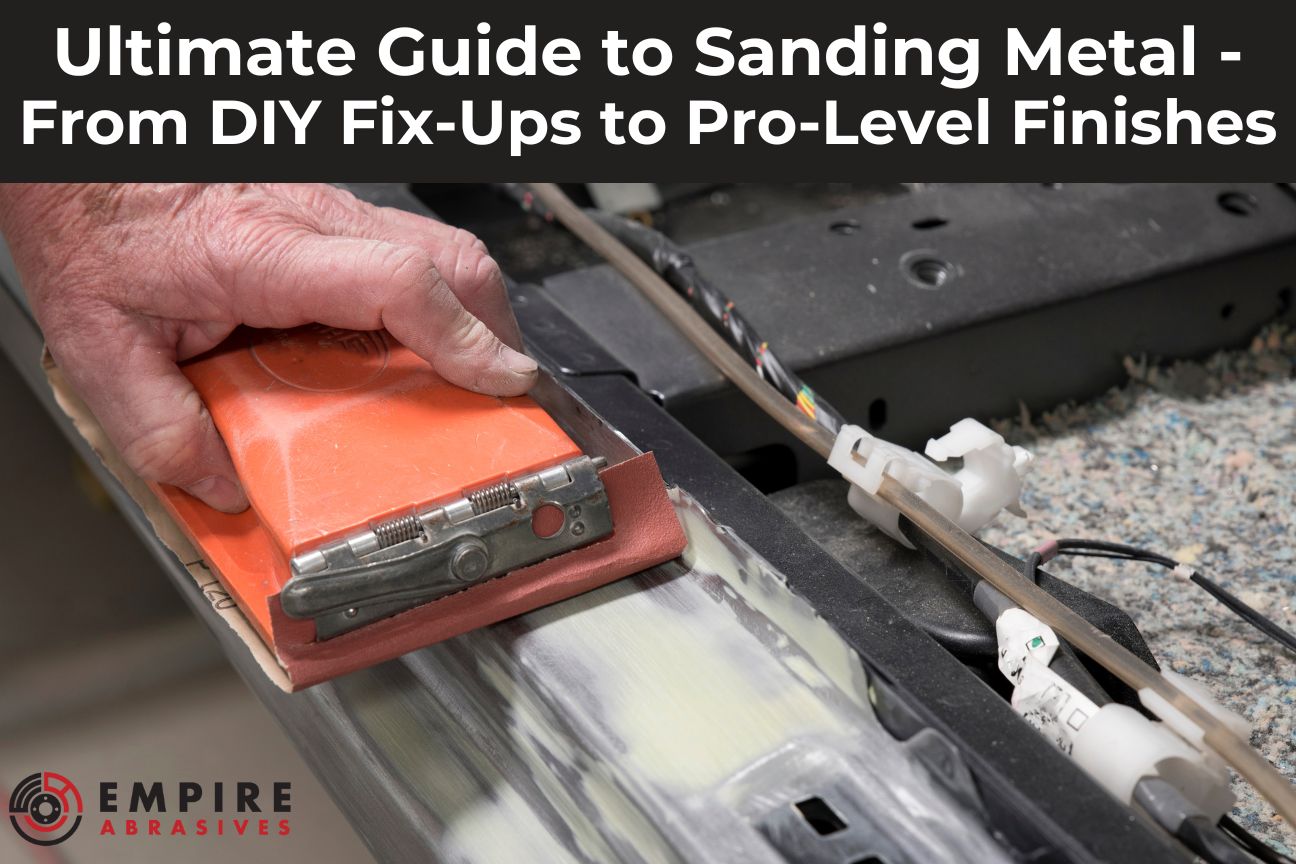
- Longboard Sanding Sheets: The go-to for auto-body work. Used on a longboard sander (manual or pneumatic) to level body filler and find high/low spots on large, flat panels.
2. The Tools (The Power)
Tool Breakdown:
- Hand Sanding: Offers the most control and is best for small, intricate, or curved surfaces where a power tool might be too aggressive. Tools like sanding sheets, shop rolls, and sanding sponges are ideal for hand sanding. Using a sanding block is recommended for distributing pressure evenly.
- Power Sanders: For larger surfaces, a power sander is the most efficient choice.
- Random Orbital Sander (Palm Sander): A must-have for paint prep. The random motion ("orbital") creates a uniform, swirl-free finish on flat surfaces.
- Belt Sander: A powerful and aggressive sander, best used for quickly removing material from large, flat surfaces.
- Longboard Sander: The essential tool for auto-body work to get panels perfectly flat and "true" before painting.
- Detail Sander: Also known as a corner or mouse sander, this tool is designed for getting into tight corners and small, hard-to-reach areas that other sanders can’t.
3. Essential Safety Gear (PPE)
This is not optional. Metal particles are sharp and hazardous to your health.
- Safety Glasses/Goggles: Protect your eyes from flying metal fragments.
- Dust Mask or Respirator: Metal dust is extremely harmful to inhale. Always wear at least an N95 mask.
- Gloves: Protect your hands from sharp metal edges, friction, and heat.
How to Sand Down Metal: Step-by-Step Metal Sanding Techniques
Now that you’ve prepp