
If you use a standard abrasive, the friction will literally melt the metal into your abrasives, making your disc useless and potentially ruining your workpiece.
Abrasives safe to cut and grind non-ferrous soft metals like aluminum must run cooler, prevent “loading”, and be free of contaminants like iron. Specialty abrasives for aluminum are often manufactured with a combination of aluminum oxide (AO) and silicon carbide (SiC) to meet these requirements.
Why Do Other Abrasives Clog Up from Aluminum?
Aluminum melts at around 1,220°F. That sounds hot, but it's only around half the temperature of ferrous metals like cast iron and stainless steel. When you grind or cut aluminum, you aren't really “cutting” in the same way you do with steel. Since aluminum is soft and malleable, instead of fracturing cleanly, it tends to deform.
- Heat from friction softens the surface
- The metal smears instead of breaking into chips
- That smeared material packs into the pores of the abrasive
Once those pores are filled, the abrasive can’t expose fresh cutting edges. At that point, it is no longer cutting, it is just rubbing.
The Efficiency Killer
A loaded disc doesn't just cut slower. It gets worse from there. It becomes a vicious cycle.
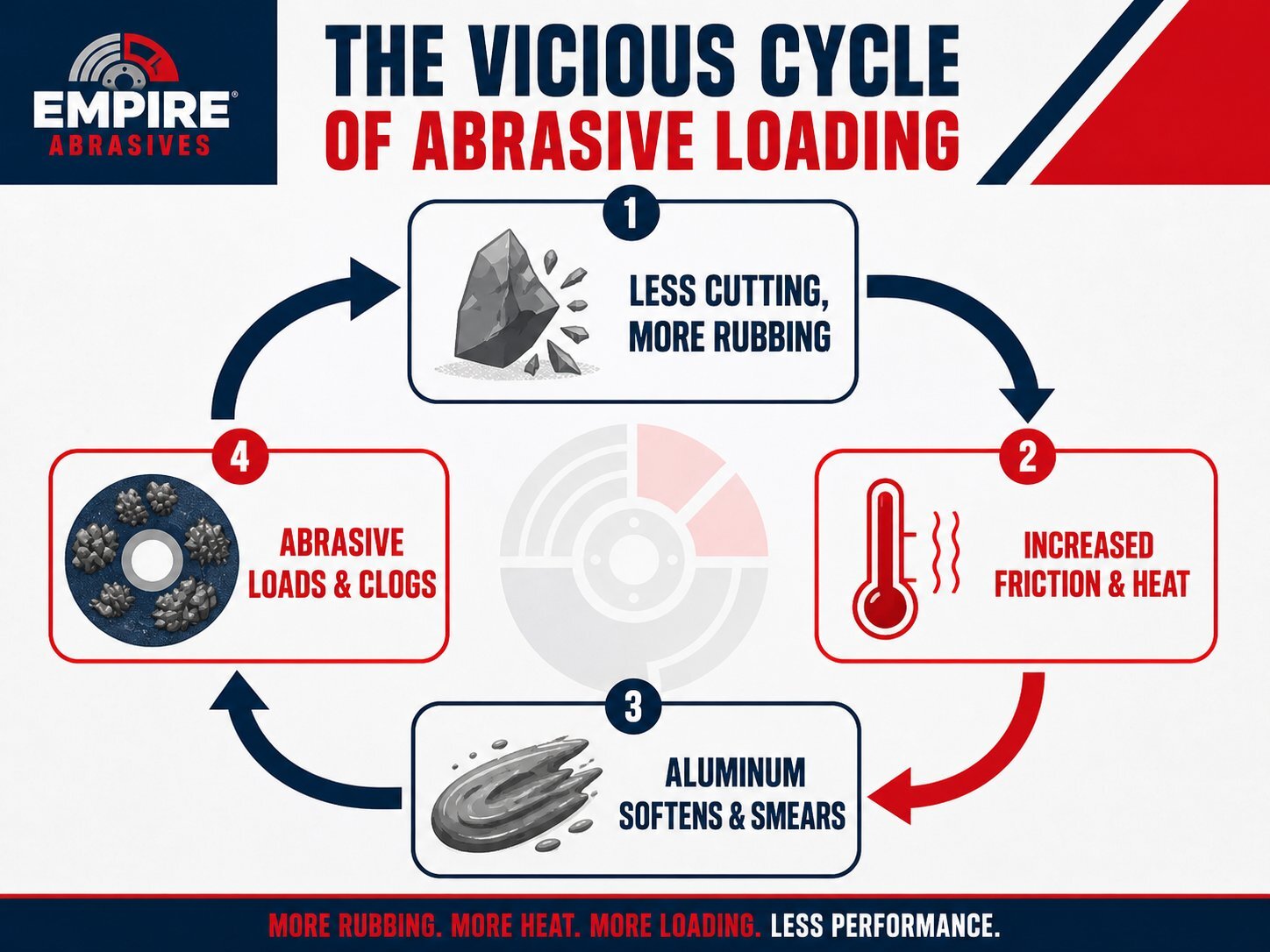
Keep it up and you'll end up with heat discoloration on the aluminum, a ruined abrasive, or seriously damaging the workpiece.
The AO+SiC Combo
Aluminum Oxide is tough and impact-resistant, which matters when you're pushing pressure into a grinding pass. On its own, though, AO tends to hold heat. It's not the right abrasive for aluminum by itself.
Silicon Carbide is incredibly sharp and brittle. It features high thermal conductivity, meaning it dissipates heat faster than AO. Because the grains are so sharp, they "bite" into the aluminum with less pressure, reducing the friction-heat that leads to melting.
However, because SiC is so brittle, it lacks the structural "toughness" to hold up under heavy pressure. Used alone, the grains would fracture and wear away far too quickly to be economical.
The synergy between them is what makes AO+SiC blends work on aluminum.
- SiC initiates the cut quickly, reducing friction and heat buildup
- AO supports and sustains the cut, preventing rapid breakdown
- The combination helps keep pores open and active
Chip Formation vs. Smearing
When an abrasive is working correctly on aluminum, it produces small, discrete chips. You can often see them flying off the workpiece. That chip-formation process is efficient: material comes off cleanly, heat is carried away with the chips, and the abrasive surface stays relatively clear.
When the abrasive is wrong for the application, you get smearing instead. The aluminum softens at the contact point and gets dragged rather than cut. No chips. No heat path. Just a thickening paste that eventually hardens into the disc. AO+SiC blends are designed to maintain that chip-cutting action on aluminum. The SiC component, in particular, is sharp enough to fracture the material rather than drag it, which is what keeps the disc cutting instead of glazing.
| Characteristic |
Correct Abrasive (e.g., AO+SiC) |
Incorrect Abrasive (e.g., Standard AO) |
|---|---|---|
|
Abrasive Action |
Grains bite and create clean chips |
Grains slide and drag material |
|
Material Removal |
Efficient stock removal, surface stays active |
Material smears and packs into the abrasive |
|
Heat Level |
Low; heat is carried away with chips |
High; friction spikes, causing melting |
|
Result |
Clean cut, usable abrasive, undamaged workpiece |
Loading, disc is ruined, workpiece may have heat damage |
Why AO + SiC Works
The sharper SiC grains help initiate true cutting, while AO keeps the structure stable. Together, they maintain a cutting action that favors chip formation instead of turning the surface into a paste.
Contamination: Why “Non-Loading” Means Cleaner Cuts
If you are working on aluminum that will eventually be painted, anodized, or welded, contamination is a major concern.
- Iron Contamination: Many standard abrasives contain trace amounts of iron or sulfur. If these particles get embedded in aluminum, they will eventually react with moisture and cause galvanic corrosion (rusting), even though aluminum itself doesn't rust.
- Cross-Contamination: Using a disc on carbon steel and then on aluminum is a recipe for disaster. Specialty AO+SiC discs are typically "contaminant-free" (containing less than 0.1% iron, sulfur, or chlorine), which makes sure your aluminum stays pure and weld-ready.
Form Factors: Cutting, Grinding, and Flap Discs
- Cutting Discs: Use an Ultra-Thin Aluminum Cutting Disc for precise kerfs. The SiC sharpness prevents the metal from "grabbing" or pinching, a common cause of kickbacks.
- Grinding Discs: Our Aluminum Grinding Wheels allow for aggressive stock removal on non-ferrous metals. The blend keeps the disc from becoming "slick," allowing you to bevel edges or take down heavy welds without stopping to clean the wheel.
- Flap Discs: By using overlapping flaps of AO+SiC coated material, you get a built-in cooling system (airflow between the flaps). This provides a superior finish on contoured aluminum parts while lasting significantly longer than standard paper discs.
- Choose the T29 Aluminum Flap Disc for aggressive blending on contours.
- Choose the T27 Flat Aluminum Flap Disc for a superior finish on flat surfaces.
Bonus: Stearate Coatings
To take performance even further, many AO+SiC products feature a stearate coating. Think of this as a "non-stick spray" for your abrasive. This soapy, wax-like layer melts at low temperatures to lubricate the cut, further preventing the aluminum from sticking to the abrasive grains.
Shop Abrasives for Aluminum
If you're working with aluminum and currently using whatever disc is already on the grinder, it's worth making the switch. The right abrasive for the job is faster, lasts longer, and doesn't leave contamination behind.
Browse our selection of aluminum-rated cutting wheels, grinding discs, and flap discs, or reach out if you're not sure which product fits your application. Our team of abrasives experts is available during business hours by phone or website chat or off-hours via email.
Frequently Asked Questions
Is Aluminum Oxide + Silicon Carbide the only option for cutting/grinding aluminum?
No, AO+SiC is not the only option. Ceramic abrasives can also work for some aluminum applications. For fine finishing, pure silicon carbide is widely used, especially for wet sanding. We recommend AO+SiC for most shops because it cuts fast, stays cool, and keeps consumable costs down.
Can I use regular aluminum oxide sandpaper on aluminum?
Yes, you can, but it's not ideal. Standard aluminum oxide will load faster than abrasives designed specifically for non-ferrous metals. For significant work or if contamination is a concern, use an AO+SiC blend, ceramic, or a stearate-coated product for cleaner results.
What is a stearate coating on an abrasive?
Stearate is a dry lubricant (usually zinc or calcium stearate) applied to the surface of coated abrasives like sanding discs and belts. It prevents the metal from sticking to the abrasive grains as heat builds up during use. On soft metals like aluminum, stearate-coated abrasives load much more slowly and tend to last significantly longer than uncoated alternatives. The tradeoff is that stearate residue on the workpiece surface needs to be cleaned off before any coating or bonding application.
Why does aluminum “gum up” abrasive discs so quickly?
Aluminum is soft and has a low melting point. Under friction, it heats up and smears instead of breaking into chips. That smeared material sticks to the abrasive surface, filling the pores and preventing the disc from cutting effectively.
Are flap discs better than grinding wheels for aluminum?
Usually, yes. Flap discs:
- Run cooler
- Expose fresh abrasive continuously
- Are less prone to loading
They are a great choice for blending, shaping, and finishing aluminum surfaces.
Further Reading
From Empire Abrasives
- Stearate Coatings Explained — Learn how stearate coatings prevent loading and extend abrasive life, especially on soft metals.
- Silicon Carbide vs Aluminum Oxide Abrasives — Compare the properties and ideal applications for SiC and AO abrasives.
- Aluminum Oxide 101 — Understand why aluminum oxide is a common and versatile abrasive for many applications.
- Aluminum Oxide vs Zirconia Abrasives — Discover the key differences between AO and zirconia for various grinding and sanding tasks.
- Cutting Metal With an Angle Grinder — Get practical tips and safety guidance for cutting various metals using an angle grinder.
About the Author
Mike Germade
Mike is the Content Specialist for Empire Abrasives, where he has spent over five years researching and writing expert resources on sanding, grinding, and polishing tools. He regularly tests products on his own woodworking and metalworking projects, combining hands-on experience with a passion for clear content that helps makers and DIYers succeed. He continually updates his work to reflect the latest products, safety standards, and industry best practices.
Last Update: 5/1/2026
Some images on this page may be AI-generated for illustrative purposes.