
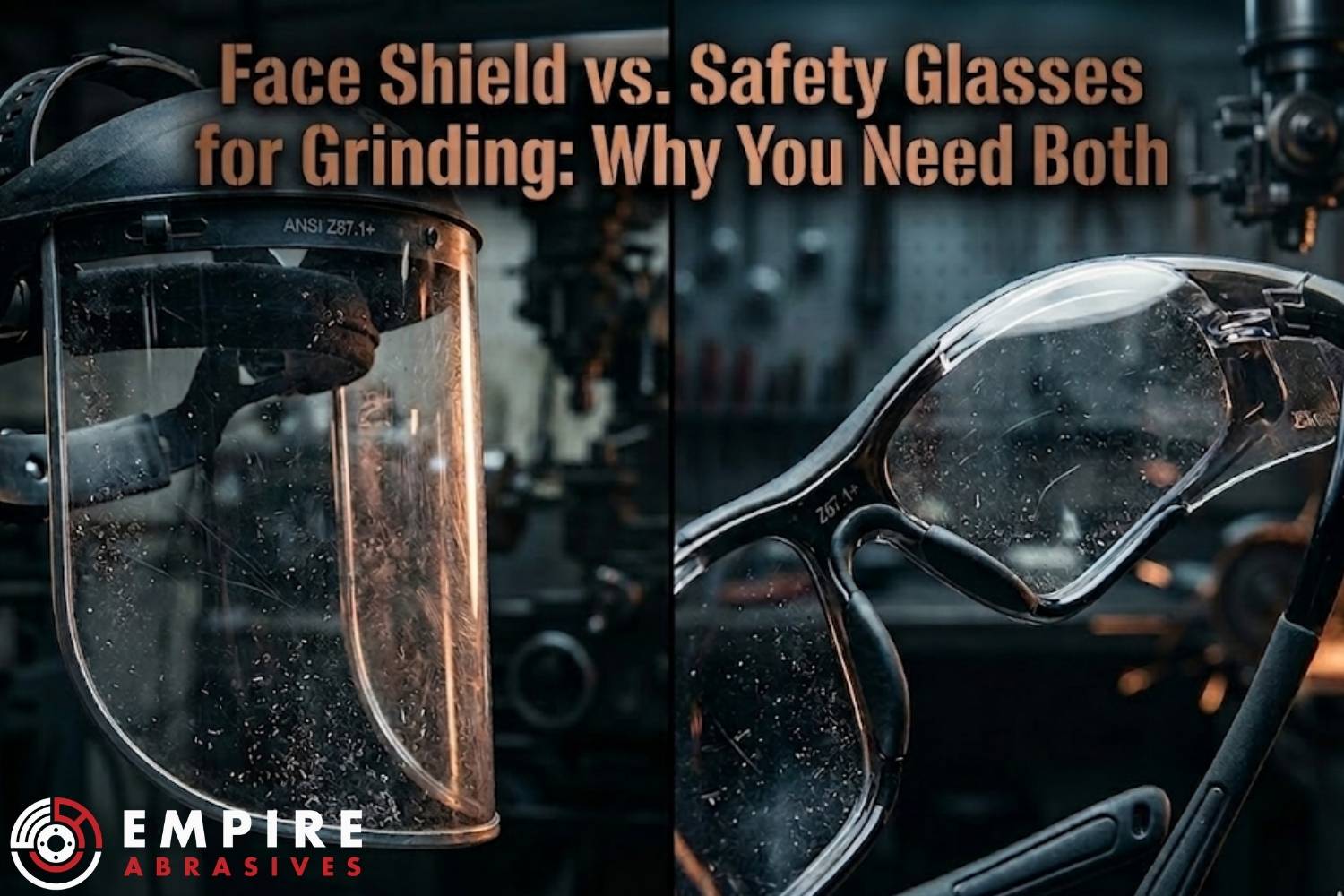
According to NIOSH, workplace eye injuries send about 2,000 Americans to the doctor each day. A significant portion of these injuries are cause by flying particles, and the scary part is that 90% are preventable with the right PPE. For grinding specifically, that means knowing which protection to wear, when to wear it, and why one piece of gear alone isn't enough.
Key Takeaways
-
Workplace eye injuries send 2,000 Americans to the doctor daily; 90% are preventable with proper PPE.
-
For grinding, always wear both a face shield and safety glasses as a complete safety system.
-
The face shield blocks most sparks, debris, and heat before they reach your face.
-
Safety glasses Protect your eyes from ricochets and anything that gets underneath or around the shield.
-
Ensure your eyewear has the ANSI Z87.1+ stamp, guaranteeing certified impact protection.
For Grinding, You Need a System – Not Just Options
We often get asked, "Should I wear a face shield OR safety glasses?" The answer is simple: it’s not a choice between this and that. For grinding, you need both. Think of it as a complete safety system. They are each designed to handle different failure scenarios.
Here’s a common scenario: you’re grinding a weld and your face shield is deflecting the main shower of sparks. But a single, hot piece of swarf ricochets off your workbench and flies up from underneath the shield. Or, just as you finish a cut, you lift your shield to inspect the work, not realizing a fragment was just sent flying by the still-spinning wheel. In both cases, the face shield is useless, but your Z87+ rated safety glasses are your failsafe, ready to deflect the rogue hot sparks or ricochets that sneak through...literally saving your vision.
-
Face Shield: Blocks the main spray of sparks, grinding debris, and intense heat, protecting your entire face.
-
Safety Glasses: Offer essential direct eye protection from ricochets, fine dust, and any stray particles that might get around the shield.
-
No Substitutions: Skipping either one creates a critical and dangerous gap in your PPE.
What Safety Glasses Actually Protect Against
Think of safety glasses as your "zero-clearance" protection. While a face shield handles the heavy spray, the glasses are there to catch the stuff that defies physics...bouncing off your chest or hooking around the edge of the shield.
Safety glasses protect against the most common grinding hazards - small particles, sparks, and debris ejected at relatively low velocity in the forward direction. Specifically:
-
Flying chips and swarf — the fine metal particles that scatter when a wheel contacts workstock
-
Spark streams — deflecting or blocking sparks from reaching the eyes
-
Incidental splatter — small coolant or lubricant drops
-
Dust and fine particulate — especially relevant with angle grinders on stone, concrete, or coated metals
We've all seen it or feared it: a grinding wheel catches on a weld or edge, and instead of stopping cleanly, it shatters...sending fragments in every direction. A proper pair of impact-rated safety glasses is designed and tested to withstand those types of scenarios. They form a close-fitting barrier that a face shield, by design, cannot. This is also why a snug, wrap-around fit is so important. Gaps on the side are an open invitation for a stray bristle from a wire wheel or a shard of metal to find its way in.
They aren’t just a shield against dust; they’re your last and most important piece of protection against the kind of impact that causes permanent damage.
What to Look For: The ANSI Z87.1+ Stamp
When you pick up safety glasses or a face shield, those small markings on the frame and lens are your guarantee of protection. While you’ll see a few different stamps, the most critical for high-speed work is ANSI Z87.1+. Here's what that means for your safety:
-
It's not just a model number. This certification from the American National Standards Institute means your eyewear meets specific safety criteria.
-
Always look for that plus sign (+).
-
Standard Z87.1-rated eyewear is tested for basic impact. However, the Z87.1+ rating means it passed a much tougher, high-impact test.
-
To earn the "+", the lens must withstand impact from a 1/4-inch steel ball traveling at 150 feet per second (over 100 miles per hour) without cracking or shattering.
-
Think about a 4.5" cutting disc spinning at 10,000 RPM. If a piece breaks off, it becomes a high-velocity projectile. The basic Z87.1 rating isn't designed for that kind of threat.
Look for the 'Z87.1+' stamp on the lens itself (often in a corner) and usually embossed on the inside of the frame arms. For face shields, this marking will typically be found on the edge of the shield or on the headgear.
Face Shields: Your Broader Defense Against Sparks and Debris
So you’ve got your Z87.1+ rated safety glasses on. That’s your critical, non-negotiable protection for your eyes.
But when you’re leaning into a piece with an angle grinder, you’re standing in a continuous shower of hot sparks and sharp metal swarf. Those glasses will stop a direct projectile from hitting your eyeball, but they won’t stop a hot piece of slag from embedding itself in your cheek or a stray wire from a cup brush catching you below the eye. Trust us, a hot spark landing on your cheek feels less like a kiss and more like a tiny, angry hornet's sting.
This is where a full face shield proves its worth.
Imagine you’re grinding down a weld in a tight corner. The sparks aren’t just flying forward; they’re ricocheting off surrounding surfaces and coming back at you from unpredictable angles. A face shield covers you from your forehead to below your chin, protecting your entire face from painful burns and lacerations that safety glasses alone can’t prevent.
Crucially, a face shield is secondary protection. It’s not an either/or choice. It must be worn over your primary Z87.1+ safety glasses, as debris can still get up and under the shield. The two work together as a system: glasses for direct impact, and the shield for broad coverage against the messy reality of grinding.
ANSI Z87.1 vs. Z87.1+: What's the Difference for Grinding?
|
Rating |
Impact Test |
Protects Against |
Best For |
|---|---|---|---|
|
ANSI Z87.1 |
1-inch steel ball dropped from 50 inches. |
General dust, light splashes, low-energy impacts. |
Basic workplace tasks, chemical handling. |
|
ANSI Z87.1+ |
¼-inch steel ball fired at 150 ft/sec (>100 mph). |
High-velocity projectiles, fragments from shattered discs. |
Grinding, cutting, chipping, high-speed machining. |
The Physics of an Angle Grinder: Why Both Are Essential
A standard 4-1/2” disc spins at over 10,000 RPM. This isn't just rotation; it's immense centrifugal force that turns every particle of metal and abrasive into a tiny, hot projectile traveling at over 100 mph at close range.
Because an angle grinder is a handheld tool, the trajectory of this debris is constantly changing and completely unpredictable. It’s not a neat, controlled stream. For example, imagine you’re cutting a piece of rebar and the wheel suddenly binds. The resulting kickback and potential wheel fragmentation won't just fire straight ahead. It creates a chaotic, 180-degree blast zone of shrapnel.
This is why you need both. Your safety glasses provide the high-impact Z87.1+ rated protection for your eyes, the most vulnerable target. Your face shield protects the rest of your face—cheeks, nose, and neck—from the wide, unpredictable spray and the painful burns that grinding sparks can cause. One without the other leaves a serious gap in coverage against the unique forces an angle grinder generates.
Don't Forget Your Ears
While you're protecting your eyes, don't forget your ears. With the intense forces and flying debris an angle grinder can unleash, remember that its dangers aren't limited to what you can see. The sheer decibel level produced by these powerful tools also poses a significant, often overlooked, threat to your long-term health.
You know that high-pitched whine an angle grinder makes under load? It can easily scream past 110 decibels. OSHA says you need hearing protection for any sustained exposure over 85 dB. The damage from this isn't immediate; it’s cumulative and irreversible. We've all seen the fabricator who skips earplugs for a 'quick 30-second cut.' That single event may seem harmless, but multiply it by dozens of similar cuts every day, week after week. Before you know it, that repeated exposure permanently damages the delicate structures of your inner ear, leading to tinnitus (that constant ringing in your ears) and hearing loss.
So, treat hearing protection with the same importance as your face shield. A solid pair of earmuffs or properly inserted foam earplugs with a high Noise Reduction Rating (NRR) is non-negotiable PPE. And seriously, take the time to roll those foam plugs thin, pull your ear up and back, and let them expand deep in your canal. Don't just jam them in. You'll know they're in right when you hear your own voice boom inside your head. That's the seal you're looking for.
Bottom Line: Use Both for Grinding
When you’re grinding, safety glasses protect your eyes from direct hits. A face shield protects the rest of your face from sparks, debris, and heat.
These aren’t interchangeable. Each one handles a different type of risk, and skipping either one leaves you exposed.
Use both every time you pick up a grinder. It only takes one bad spark or fragment to cause permanent damage.
Frequently Asked Questions About Grinding Safety
Can I wear a face shield over my prescription glasses?
Yes, A face shield should always be worn over Z87.1+ rated safety glasses, even if you wear prescription glasses. For those who wear prescription glasses, Over-the-Glass (OTG) safety glasses are the ideal solution. These are specifically designed to fit comfortably and securely over most standard prescription frames, providing a Z87.1+ rated impact-resistant barrier and a protective seal around your eyes without interfering with your vision. Relying on your regular prescription glasses for impact protection isn't enough, as they often aren't rated for high-impact resistance.
What does ANSI Z87.1 mean on safety glasses?
ANSI Z87.1 is an occupational eye protection certification, signifying eyewear has passed rigorous impact resistance tests. Basic Z87.1 protects against impacts like a 1-inch steel ball dropped from 50 inches. For metalworking and high-velocity hazards, always choose Z87+; this rating withstands a ¼-inch steel ball shot over 100 mph, providing superior protection.
Do I need a face shield for a bench grinder?
Yes, absolutely. A bench grinder's wheel can still throw debris unpredictably. Apply the same two-part system: Z87.1+ safety glasses for primary impact protection, with a face shield worn over them for full facial coverage.
Is a grinding face shield the same as a welding helmet?
No, they are not the same. Welding helmets protect from UV/IR with heavily shaded lenses (e.g., Shade 10-13); while "grind mode" is lighter (Shade 3 or 4), it's not truly clear. A dedicated grinding face shield provides completely clear, ANSI Z87.1+ rated polycarbonate for high-impact protection and optimal visibility during prolonged grinding.
How often should I replace my face shield or safety glasses?
Replace your face shield or safety glasses when its condition compromises your view. Scratches, haze, or gouges weaken the lens's structural integrity, potentially failing to meet its ANSI Z87+ impact rating. A clear view is essential for safe, accurate work, and a replacement is cheap insurance.
Further Reading
From Empire Abrasives
-
Essential PPE for Abrasive Work: A Guide to Sanding and Grinding Safety — Learn about the vital personal protective equipment needed for safe sanding and grinding operations.
-
Portable Cutoff Wheel Safety - Do’s, Don’ts, and Safe Practices — Understand best practices and essential safety guidelines when using portable cutoff wheels.
-
Choosing the Right Sanding Belt — Discover how to select the optimal sanding belt for your specific abrasive tasks.
-
Choosing the Right Sanding Disc — Find guidance on selecting the best sanding disc for various applications and desired finishes.
-
Precision vs. Power: Choosing Between a Cutting Wheel and a Reciprocating Saw — Explore the differences and appropriate uses for cutting wheels compared to reciprocating saws.
External Resources
-
Eye Safety (NIOSH | CDC) — Provides comprehensive information and statistics on preventing workplace eye injuries.
-
Ten Ways to Prevent Eye Injuries at Work (Prevent Blindness) — Offers practical tips and strategies to minimize the risk of eye injuries in occupational settings.
-
Eye protection (ISHN) — Discusses crucial aspects of eye protection, including ANSI standards and selecting appropriate eyewear for various hazards.
About the Author
Mike Germade
Mike is the Content Specialist for Empire Abrasives, where he has spent over five years researching and writing expert resources on sanding, grinding, and polishing tools. He regularly tests products on his own woodworking and metalworking projects, combining hands-on experience with a passion for clear content that helps makers and DIYers succeed. He continually updates his work to reflect the latest products, safety standards, and industry best practices.
Last Update: 3/26/2026
Some images on this page are AI-generated for illustrative purposes.