
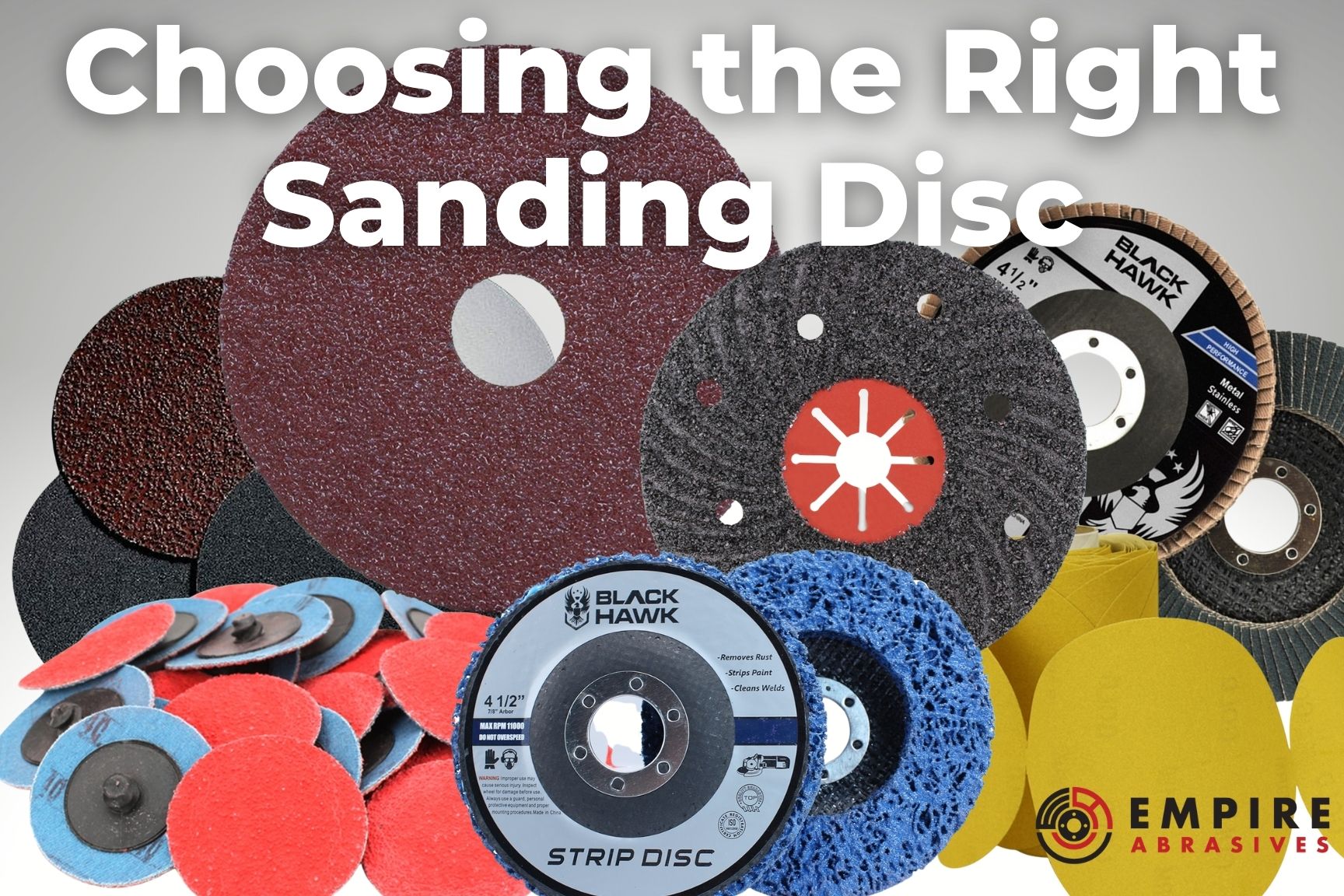
Sanding is a crucial step in woodworking, metalworking, and many other industries. The type of sanding disc you choose can significantly impact the efficiency and quality of your work. At Empire Abrasives, we understand the importance of using the right sanding disc for the job at hand.
With so many different options available (like type of sanding disc, different abrasive grains, grit size, bonding types, etc.), selecting the right sanding disc can get overwhelming pretty quickly. That's why we've put together this comprehensive guide to help you choose the best sanding disc for your needs. Whether you're a professional fabricator or a DIY enthusiast, we have the knowledge and expertise to guide you through the process.
In this blog post, we will guide you through the process of choosing the right sanding disc, exploring the different types and their applications. We will help you navigate factors like grit size, material compatibility, and disc attachment methods. We'll also provide tips and advice on how to use them safely and effectively. With this helpful guide, you'll have a clear understanding so you can make a better decision when choosing the best disc for sanding, and you'll be able to achieve the best results every time.
In order to determine the best sanding disc for your task, we put together a few questions for you to ask yourself to help narrow down your search.
- What is being sanded?
- What is the material (wood, metal, plastic, etc.)
- What is the condition of the material? (rough, smooth, painted, finished, etc.)
- How big is the work area?
- Is the surface flat or contoured?
- What are your project goals?
- Are you focusing on material removal, smoothing, or polishing?
- Do you need to remove substances like paint or rust?
- What are your sander and disc specifications?
- What type of sander are you using? (Angle grinder, random orbital sander, etc.)
- What attachment method does your sander use? (Backing Pad, Hook-and-loop, PSA adhesive, Roloc, etc.)
Different Types of Sanding Discs
Before we discuss how the different answers to those questions above should affect your decision, we’ll give a brief overview of the different types of sanding discs as well as the different abrasive grains so the recommendations make more sense.
Resin Fiber Discs
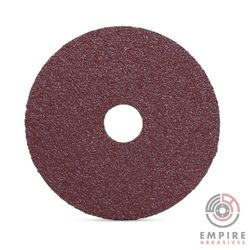
Resin fiber discs are made up of abrasive grains bonded with resin to a vulcanized fiber backing. They are cost effective sanding disc used for general purpose grinding and finishing on metals, plastic, and woods.
These discs attach to angle grinders with an appropriate backing pad. Resin fiber discs are heavy-duty and abrasive, and are expertly manufactured for a range of applications ranging from surface blending to heavy stock removal.
Best For: Heavy stock removal, deburring, general sanding, surface blending, and rust removal on metal.
Flap Discs
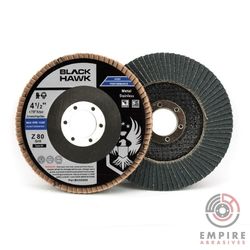
Flap discs are an innovative type of sanding/grinding wheel popular abrasives among welders and metal fabricators. They are made up of overlapping flaps of coated abrasive cloth strips fixed to a firm backing.
As each layer of abrasives wear down from use, new flaps of untouched abrasive grains come to the top, keeping a consistent cutting performance. Compared with grinding wheels, the flaps give you more flexibility on contoured work pieces and a softer grind.
Specialty Flap Discs:
- Curved Flap Discs: Designed with a unique curved edge, these excel at detailed grinding and finishing, particularly in tight corners and along fillet welds
- Calcium Coated Flap Discs for Aluminum: These discs are designed with a calcium stearate coating that liquefies during use, reducing heat buildup and preventing clogging. This makes them ideal for soft metals like aluminum.
- Mini Flap Discs: Compact yet powerful, 2” and 3” mini flap discs are ideal for intricate grinding and finishing jobs. Their smaller size offers better control and access in tight spaces
Best For: Metal fabrication, weld smoothing, removing mill scale, blending welds, contouring and shaping surfaces, and general sanding/grinding
Recommended Reading -
- T27 vs T29 Flap Disc Differences
- Flap Discs Uses and Differences Guide for a Great Multi-Tool
- Can You Use Flap Discs to Grind Aluminum?
- Flap Discs vs Grinding Wheels: A Side-by-Side Comparison
Hook and Loop Discs
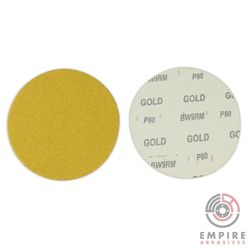
Hook and loop sanding discs are made up of abrasive coated cloth, paper, or film with a backing material similar to Velcro. There are a system of small hooks and loops that are used to affix the sanding disc to the sander. This makes it extremely easy to change the disc, without having to sacrifice on the quality of the disc used. If your sander isn't made to be used with hook and loop sanding discs, you can purchase a converter pad which will enable them to fit on your sander.
Hook & loop discs come in a variety of sizes to fit die grinders up to larger angle grinders. This gives you the ability to cover large areas or narrow in on a smaller detailed sanding task.
Best For: Versatile applications on wood and metal with quick grit changes
Quick Change Discs
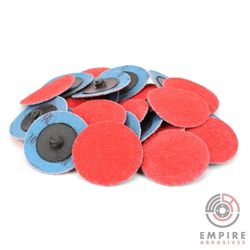
Quick change discs are the go-to choice for grinding, deburring, and blending in small areas and tight corners. The simple to use fastening system makes quick change discs the ideal option for users looking to maximize their productivity. These discs are great for grinding, deburring, and blending in tight spaces or on small surfaces
Best For: Precision work, especially on metal and when working in small or hard to reach areas
PSA Discs
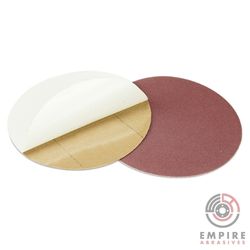
PSA (short for pressure sensitive adhesive) sanding discs are very popular among woodworkers and auto body professionals that typically work on flat surfaces. They have a sticky backing that creates a firm attachment to the power sander.
These types of discs are suitable for prolonged usage, with many workshops opting to use them until the abrasive is completely spent.
Best For: Extended use on flat surfaces, particularly wood and metal
Semi-Flexible Discs
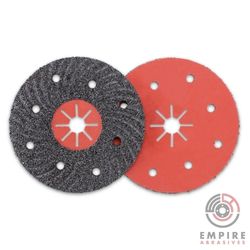
Semi-Flexible Discs are heavy-duty grinding discs made with silicon carbide abrasive and a ribbed, semi-flexible backing. These discs are designed for aggressive stock removal on hard materials like stone, concrete, and masonry.
The ribbed design helps channel debris away from the surface, reducing clogging and improving grinding efficiency. Their semi-flexible nature allows them to conform slightly to the surface, making them ideal for uneven materials.
Best For: Heavy grinding on stone, concrete, and masonry
Shop Semi-Flexible Grinding Discs
Surface Conditioning Discs
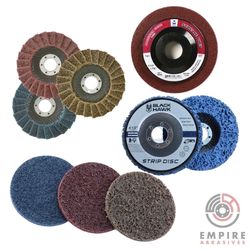
Surface conditioning discs include a variety of specialized discs for surface preparation and finishing tasks. Unlike the coated abrasives we’ve mentioned so far, they are made up of non-woven webs of nylon fibers impregnated with abrasive grains.
They are used for various metal tasks like rust removal, polishing, and deburring. Their open structure design minimizes loading/clogging, reduces heat build-up, and efficient removal of materials like paint and rust without damaging surfaces.
Best For: Finishing, rust removal, polishing, blending, and surface preparation on metal
Shop Surface Conditioning Discs
Recommended Reading:
Need Quick Expert Advice?
No matter the job, our sanding discs can help you get it done. If you need assistance with selecting the right product for the job, feel free to call (800-816-3824), email, or chat with one of our experts today.
Abrasive Materials
The abrasive materials are the sharp grains embedded in the disc that do the actual grinding. The different abrasive grains have varying properties that each have their pros and cons. The most common abrasive materials used in sanding discs include aluminum oxide, zirconia alumina, ceramic, and silicon carbide. Then there is non-woven, which has its own pros and cons.
Aluminum Oxide:
Aluminum oxide is the most used material for most abrasive products, including sanding discs. This grain is suitable for sanding and grinding a variety of materials such as wood, most metals, and plastics. It is affordable, versatile, and has good durability. However, it may not be as effective for harder materials such as stainless steel.
Suitable For: Most Ferrous Metals (including cast iron, carbon steel, alloy steel, wrought iron), composites, plastics, and wood
Example - 2" Aluminum Oxide Die Grinder Sanding Discs
Zirconia Alumina:
Zirconia alumina, aka “Zirc”, is tougher than aluminum oxide and is used for sanding harder materials such as stainless steel, cast iron, and titanium. It has a longer lifespan and is more heat-resistant than aluminum oxide, making it ideal for heavy-duty grinding and sanding applications. Zirconia is also a great choice for high-pressured grinding and machining applications.
Suitable For: Wood, Stainless Steel, Unalloyed Steel, Non Ferrous Metals such as Carbon Steel, Aluminum, Brass, Bronze, Copper, Rubber, and Painted Surfaces
Example - 4-1/2" Curved Flap Disc
Ceramic:
Ceramic abrasive material is designed to handle extremely tough sanding applications. It is ideal for grinding hard metals, such as steel and titanium, ferrous metals, and carbon steel. It is extremely durable, self-sharpening (friable), and resistant to heat, making it a good choice for high-speed grinding.
Suitable For: Super Alloys, Unalloyed Steel, Heat Sensitive Metals like Stainless Steel, Nickel and Cobalt, Aluminum and all Non Ferrous Metals including Copper, Brass, Gold, Silver, and Tin
Example - 4-1/2" Ceramic Resin Fiber Sanding Discs
Diamond:
Diamond abrasives are the most durable and longest lasting abrasive materials. Diamonds are the hardest naturally occurring substances, making them capable of grinding and sanding extremely hard materials such as concrete, stone, and glass. However, diamonds are obviously very expensive, making these the most expensive abrasive material.
Silicon Carbide:
This abrasive material is razor sharp and ranked just slightly below diamonds on the hardness scale. Like ceramic, silicon carbide is also friable/self-sharpening, giving it the ability to have faster removal rates than other abrasives. It is best suited for sanding non-ferrous metals such as brass, copper, and titanium. It is also suitable for grinding glass, plastics, and refinishing hardwood floors. It is known for its aggressive cutting action and excellent finish. However, it is not as durable as other abrasive materials and may wear out quickly.
Suitable For: Marble, Granite, Cement, Stone, Glass, Plastic, Composite, Rubber, Epoxy, Resin, Paint, Fiberglass, Non-Ferrous Metals
Example - 5" Silicon Carbide Sanding Disc
Non-Woven:
Non-woven sanding discs are a bit different than the coated abrasives mentioned above. These discs are constructed with a nylon-webbing, usually impregnated with abrasive grains. They are less abrasive than coated abrasives, making them ideal for finishing surfaces.
Example - 4-1/2" Paint Stripping Wheel
Additional Resources
- Are Ceramic Abrasives Better?
- Ceramic vs. Zirconia Abrasives: Which is the best option?
- Silicon Carbide vs Aluminum Oxide Abrasives
- Aluminum Oxide vs Zirconia Abrasives
Choose The Best Sanding Discs for Different Applications
Now that you know more than you ever thought you needed to know about sanding discs, let's go over those questions to determine which disc you should use.
Main Questions to Ask Yourself When Choosing a Sanding Disc
1. What is being sanded?
As you can see in the section above about different abrasive grains, each type is better suited for different surfaces. The condition, size, and shape of the surface will mean different types of discs and grits to choose from.
- What is the material (wood, metal, plastic, etc.)
- Wood: Silicon carbide or aluminum oxide discs work well for wood. If dust is an issue, consider gold sandpaper discs with vac holes. Silicon carbide is preferred for finishing tasks due to its finer grit options and can be used for wet sanding.
- Metal:
- Aluminum Oxide: A great option for general metalworking, including ferrous and non-ferrous metals.
- Zirconia: Best suited for steel and stainless steel, zirc grains are durable and offer a good balance between material removal and longevity.
- Ceramic: Recommended for harder metals, including stainless steel and high-carbon steels. Ceramic is also great for heat sensitive metals.
- Silicon Carbide: Though less common for metal, this abrasive can be used for polishing non-ferrous metals.
- Plastic and Acrylics: These materials can melt or clog abrasive surfaces. Use silicon carbide or aluminum oxide discs with an open coat and lower grit to manage heat and avoid prolonged contact in one area.
- Composite Materials: Grinding composite materials like fiberglass or carbon fiber requires discs that can handle the tough fibers without getting clogged. Film backed sanding discs, or discs with silicon carbide or are often recommended for their ability to cut through these material